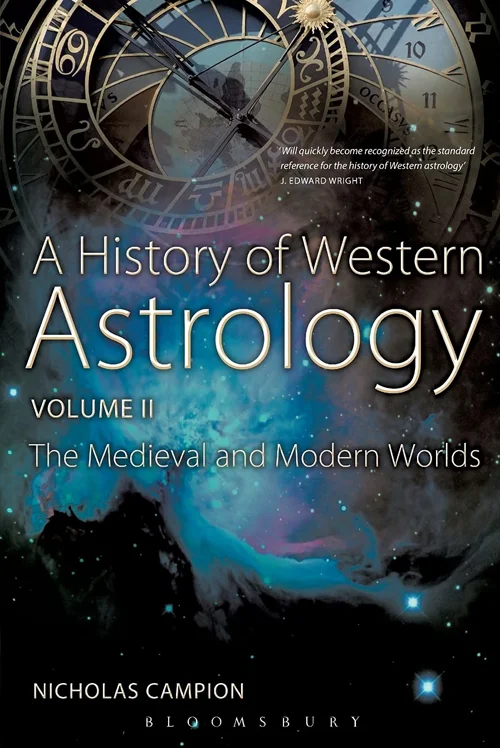
Nicholas Campion
A History of Western Astrology Vol. 2: The Medieval and Modern Worlds
Bloomsbury 2009
ISBN: 9781441181299 (paperback)
The book is available as a paperback and ebook. You can order it from your local bookshop.
Astrology is a major feature of contemporary popular culture. Recent research indicates that up to 99% of adults in the modern west know their birth sign. In the modern west astrology thrives as part of our culture despite being a pre-Christian, pre-scientific world-view. It is important to understand astrology’s current extent and character in order to have a full picture of modern culture, and t understand the present it is necessary to engage with the past – with history.
This is the first comprehensive examination of the history of western astrology in the medieval and modern worlds from the fifth century to the present day. I explore the relationship between astrology and religion, magic and science, and explore its use in politics and the arts. My overall conclusion is that astrology, as the practice based on the assumption that the movement and appearance of the stars and planets have significance for human affairs and life on Earth, whether as signs, influences, or causes, has diverse perspectives and applications. There is therefore no one single account of the history of western astrology, but multiple narratives. Concluding with a discussion of astrology’s popularity and appeal in the twenty-first century, I ask whether it should be seen as an integral part of the modern world or is out-of-step with modern values. My conclusion is that it is an integral part of the modern world. The book is a companion to the first volume which covers the ancient world, and to Astrology and Cosmology in the World’s Religions.
“An extremely impressive synthesis. Campions two volumes will set a new standard for his histories of astrology, and are themselves a significant contribution to our cultural self-knowledge”. – Patrick Curry, University of Kent
“Campion provides an accessible, humanistic treatment that explores the relationship of astrology to the histories of religion and magic as well as that of science”. -Antony Aveni, ‘Book Review: Nicholas Campion, The Dawn of Astrology: A Cultural History of Western Astrology’, Vols 1 and 2, Time and Mind: the Journal of Archaeology, Consciousness and Culture, vol. 3, issue 3, November 2010, pp. 343 – 346
Table of Contents
Introduction: Origins and Background
1 The Latin West: Decline and Disappearance
2 The Carolingian World: Survival and Recovery
3 The Twelfth Century: Renaissance and Revival
4 The Thirteenth Century: The Aristotelian Revolution
5 The Thirteenth Century: Practice and Problems
6 The High Middle Ages: The Medieval Cosmic State
7 The Renaissance: The Pagan Revival
8 The Renaissance: Radicalism and Reform
9 The Sixteenth Century: Reformers and Magicians
10 The Seventeenth Century: Horoscopes and Telescopes
11 The Seventeenth Century: Practitioners and Politics
12 The Eighteenth Century: Newton’s Children
13 The Eighteenth Century: Magicians and Poets
14 The Nineteenth Century: Enlightenment Entrepreneurs
15 The Nineteenth Century: Magicians and Sociologists
16 The Nineteenth Century: The Theosophical Enlightenment
17 The Twentieth Century: New Age and Ancient Teachings
18 The Twentieth Century: Psychology and the Popular Press
19 The Twentieth Century: Sceptics and Scientists
20 The Twenty-First Century: Epilogue