Nicholas Campion
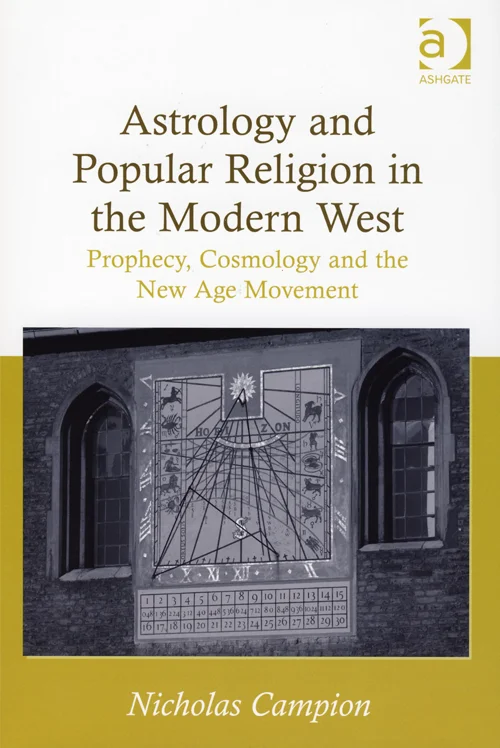
Astrology and Popular Religion in the Modern West: Prophecy, Cosmology and the New Age Movement
Ashgate 2012; Routledge, 2015.
ISBN: 9781409435143 (paperback)
The book is available as a paperback and eBook. You can order it from your local bookshop.
This book is the first in-depth examination of important themes in modern western astrology, focussing on the USA and UK. It is part history, part sociology and part anthropology. It begins by exploring astrology in its millennial or millenarian context, both terms which describe the belief that the world is about to enter a new, better era. It is one of three books which focus on these beliefs, the other two being The Great Year and The New Age in the Modern West. As applied to astrology, this mainly means belief in the coming spiritual New Age, timed by the coming Aquarian Age, and the development of spiritual and psychological forms of astrology in which the focus is on self-development and awareness, rather than prediction.
The second part of the book examines the extent and nature of belief in astrology, mainly in the English speaking world, but also touching on other countries where I conducted research, including Brazil, Argentina, Norway and Serbia. I asked around a thousand delegates at astrology conferences about their views on astrology, and whether it’s a science, a spiritual vocation, or a means of predicting the future. I then interviewed fifty astrologers in depth.
My conclusions are, first, that astrology is a mainstream feature of modern popular culture in the English-speaking world (rather than marginal as many previous studies maintain), that it consists of a diversity of practices and theories, and that, in some forms, it is part of modern vernacular religion, by which I mean the total body of what most people believe and do, rather than what is sanctioned by religious or scientific authorities. This is not a matter of astrology’s truth but its cultural function and utility.
The book is important for everyone who has an interest in modern astrology’s nature, whether practitioners or sceptics, and academics in the history of ideas, the study of religions, sociology and anthropology.
“This work is valuable for both scientists of religion and historians with an interest in the development of esoteric movements and ‘New Age’ as well as the recent history of astrology from the end of the 19th to the early 20th century. It is also of interest to astrologers who want to look beyond the horizon of everyday practice, and would like to counter the partly ineffable polemic of ideological skeptics with substanitated arguments and facts.” –
Gerhard Mayer, Journal of Scientific Exploration Media
The book is aimed at addressing the reductionist and dismissive take that “astrology is…a bizarre survival from pre-scientific times” and instead proposes to illuminate the relationship between “traditional and non-traditional beliefs,” as well as astrology’s role as a belief system, rather than a subversion, of modernity. In particular, the scientism of the NAM is shown to be an important aspect of its rhetoric through both historiographical resources and fieldwork involving qualitative data collection and discourse analysis. Campion presents us with a rounded methodological approach to researching the subject of astrology as well as a clear and concise consideration of its forms and functions. This volume is highly recommended.
Beth Singler, Religious Studies Review, 2014, Vol.40 (4), pp.195-196
Table of Contents
1 Introduction: a million-dollar business?
2 Cosmic liberation: the pursuit of the millennium
3 The shock of the new: the age of Aquarius
4 Celestial enlightenment: the new age
5 End times: the new age and the age of Aquarius
6 The writing of heaven: new age astrology
7 Oracles to the vulgar: sun-sign astrology
8 An evolutionary paradox: the survival of belief in astrology
9 Salvation and the stars: astrology, religion and belief
10 Superstitious times: the extent of belief in astrology
11 Belief in astrology: a public survey
12 In their own words: the astrologers’ universe of discord
13 With their own voices: interviews with astrologers
14 Conclusion: modernity and normality