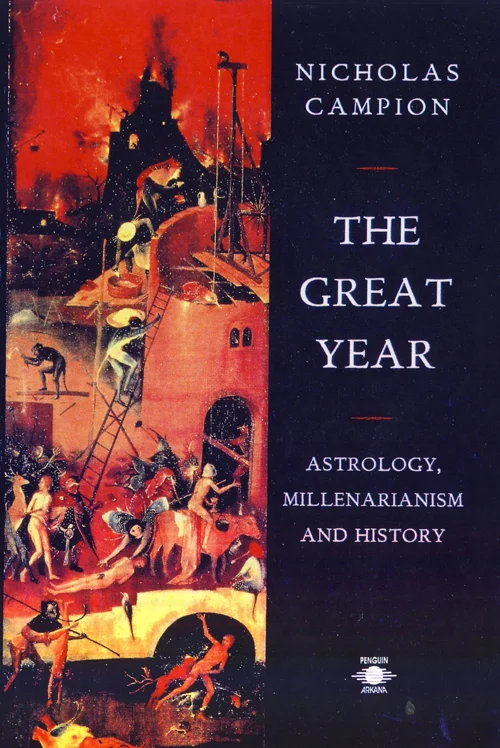
Nicholas Campion
The Great Year: Astrology, Millenarianism and History in the Western Tradition
Penguin 1994
ISBN: 9781441181299 (paperback)
This was the first of my three books to consider western theories that history is divided into set stages, or subject to cycles, the other two being The New Age in the Modern West and Astrology and Popular Religion in the Modern West. These ideas are usually known as millennial or millenarian. From ancient Mesopotamia to modern Marxism and Progress theory, via Jewish and Christian beliefs in the coming Kingdom of God, classical Greece, medieval Europe and the Renaissance, I trace the belief that the current phase of history is preceded by a past Golden Age, or will lead to a future one, that stages of history repeat, sometimes only in broad themes, sometimes down to the tiniest detail. I consider the paradoxical belief that the future is predetermined yet will only come about if we actively work to make it happen. Throughout I explore the role of astronomical and astrological ideas: from earliest recorded history the observation that the stars and planets move in regular, predictable cycles encouraged the belief that there must be corresponding regular and predictable cycles in human and historical affairs.
The book was inspired by G.R Collingwood’s The Idea of History, Karl Popper’s two books, The Open Society and its Enemies and The Poverty of Historicism and Norman Cohn’s Pursuit of the Millennium.
The book is current out of print but available second hand if you can find it.
“Campion rightly points out in this densely researched study that golden age and new age myths reduce humanity to a single mass, all of whom must be subject to a single, cosmically sanctioned order. Here lie the roots of totalitarianism” – Robin Blake, The Independent on Sunday (London)
“Exhilarating reading…an impressively encyclopaedic documentation of the extraordinary contemporary potency of ancient religious myth, and the extent to which modern conceptual thought is not so much a unique reaction against it as yet another variation of it” -Patrick Curry, Times Literary Supplement (London)
“Fascinating and contentious…a wildly eclectic, personal view of history” – Nicholas Lezard, The Guardian (London)
“An excellent introduction to astrology’s long and potent hold on the human imagination” – Michael Sheldon, The Daily Telegraph (London)
“Campion shows, in this very remarkable book, the common source in Christian millenarianism, Marxism and cyclical and apocalyptic theories of history” – John Heath Stubbs, Contemporary Review (London)
“This book is the best sort of megahistory, and solid proof that historians can still tackle huge questions at a time when they are so often associated with narrow specialities. It confronts two fundamental issues, of the attitudes of humans to time and to destiny, and uses them to fuse together politics, theology, philosophy and magic over five thousand years. This is more than a history of ideas, it is a history of instincts” – Ronald Hutton, Bristol University
“Campion’s explication of the apocalyptic template for Western thought becomes a tour de force, particularly in regard to ancient material. But as we get near the present day, his insights, in my view, become more remarkable. Though the classical background of the American republic and the parallels of Marxism to Judeo-Christian eschatology, have been noted before, Campion puts them with characteristic verve and precision.
Students of Theosophical history are sure to find, both in the material specifically on that subject and in general reflections on time and history that grow out of deep reflection on the same Pythagorean, Platonic, Gnostic and other sources for eschatological thought which Theosophy mined, much in The Great Year that is well worth reading” -Robert Ellwood, University of South California, Theosophical History
“The Great Year is an impressive book, not only for its scholarship and the wealth of objective information it contains, but as a book for its time. As millennial feelings come to a climax in the popular mind (with help from certain esoteric quarters), Campion sounds a note of Cambridge scepticism, demonstrating by his own work that one does not have to join in the parade of enthusiasts, tyrants, and idiots which has been marching since the dawn of history” – Joscelyn Godwin, Colgate University, Aries
“A monumental study of historical schemes…Campion’s provocative thesis should be required reading in common rooms everywhere” – Damian Thompson, The End of Time.
“An excellent reflection on apocalypse” – Marina Benjamin, Living at the End of the World
“This book is a fascinating trawl through the continuous influence of astrological symbolism. It is full of bombshells, dropped in the most deadpan manner. Every assertion is backed with a footnote, and an extensive bibliography invites us to share the author’s wide-ranging scholarship. It should become a basic reference work and is a treasure trove for the serious researcher” – Prudence Jones, Author A History of Pagan Europe, AA Journal
“Campion is one of those rare individuals who spans disciplines in an age of specialisation. He is uniquely capable of seeing connections between esoteric theories and their consequences for human religious belief and political behaviour. If, during the next four years, you want to keep your head while others around you are losing theirs, read The Great Year.” – Priscilla Costello, Gnosis
“It is difficult to sum up this thoughtful and erudite book in one paragraph. For astrologers, it is so important that it is bound to become a classic work. A very important source book, it supports its many deep insights with vital background information.” – Karen Hammaker-Zondag, Symbolon.
“This is a book which Nicholas Campion is uniquely fitted to write. it is an heroic achievement, exploring and presenting lucidly a vast amount of material – material which in the past has had far too little open minded consideration.” – Annabella Kitson, editor, Astrology and History, The Quarterly.
“The Great Year is a masterwork. It is the work to define any thinker’s lifetime. It stands powerful and practical, fresh yet mature, spirit rich and helpfully wise to guide thought further, to make future time happen, to welcome meaning into experience as time continues.” – Noel Tyl, The Mountain Astrologer.